
OpenAI o1 is a frontier reasoning model designed to handle complex multi-step tasks with advanced accuracy. Released in December 2024, o1 represents a significant advancement in AI capabilities, particularly in areas requiring deep reasoning, mathematical computation, and complex problem-solving.
Key Features
o1 is production-ready with key features to enable real-world use cases, including:
- Tool calling: Seamlessly connect o1 to external data and APIs.
- Structured outputs: Generate responses that reliably adhere to your custom JSON Schema.
- Vision capabilities: Reason over images to unlock many more applications in science, manufacturing, or coding, where visual inputs matter.
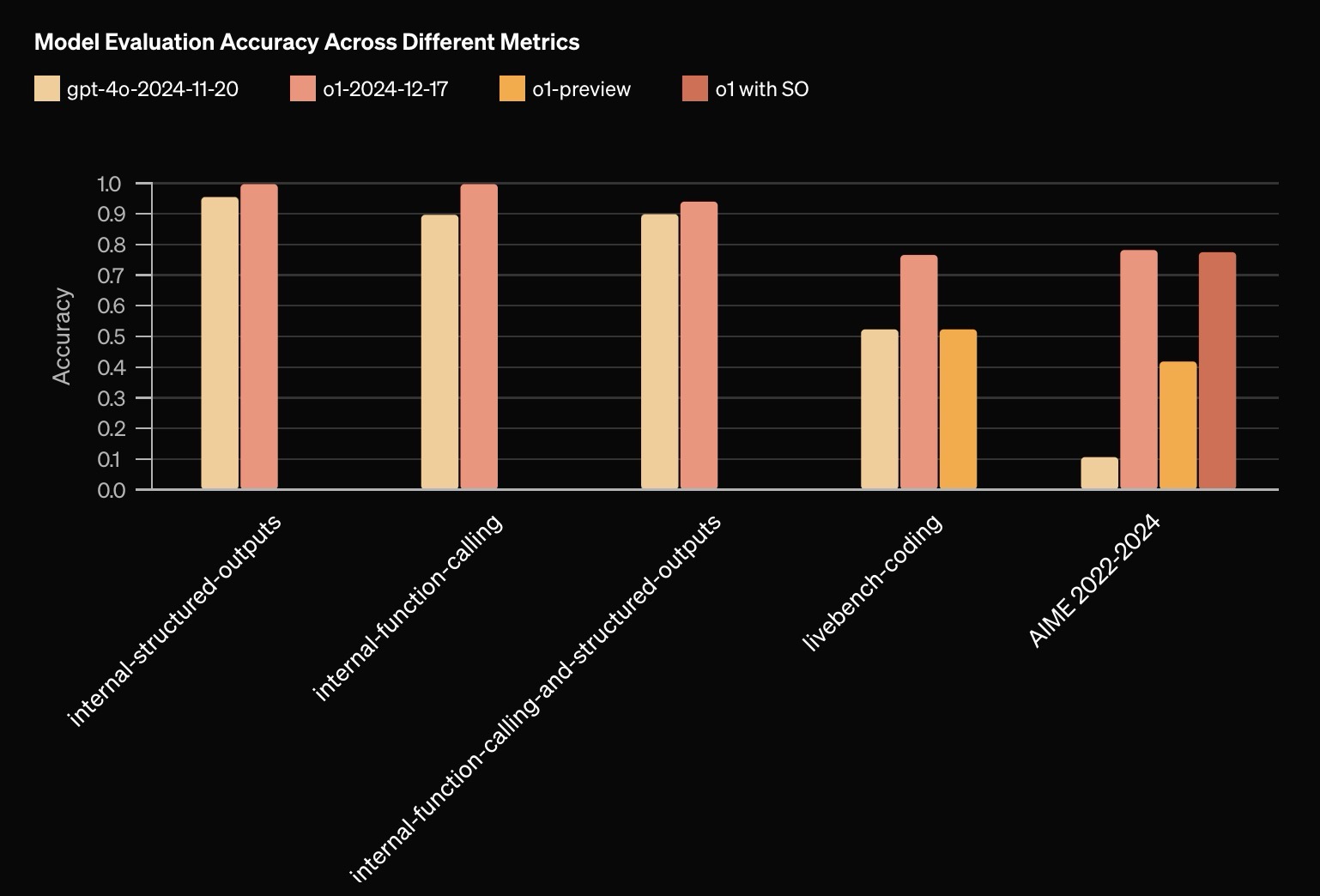
- Lower latency: o1 uses on average 60% fewer reasoning tokens than o1-preview for a given request.
- Enhanced Reasoning: Trained to spend more time thinking before responding, solving harder problems in science, coding, and math.
- Reasoning effect: A new
reasoning_effortAPI parameter allows you to control how long the model thinks before answering. - Advanced Problem-Solving: Excels in challenging tasks like physics, chemistry, biology, and complex mathematics.
- Performance in Math and Coding: Scored 83% on International Mathematics Olympiad (IMO) qualifiers and reached the 89th percentile in Codeforces coding competitions.
- Improved Safety Features: Utilizes reasoning to follow safety and alignment rules, scoring 84 on difficult jailbreaking tests (compared to 22 by GPT-4o).
- AI Safety Partnerships: Collaborating with U.S. and U.K. AI Safety Institutes, providing early access for research, evaluation, and safety testing.
- Target Users: Designed for researchers and developers tackling complex problems in fields like healthcare, quantum physics, and multi-step workflows.
Langbase Recommendations
- STEM Developers: Ideal for building applications that require mathematical reasoning or multi-step workflows.
- Researchers in Science and Math: Great for generating complex formulas and analyzing data in fields like quantum physics or biology.
- Data Analysts: Suitable for data-heavy tasks requiring advanced reasoning and problem-solving capabilities.
- AI Developers: Cost-efficient option for creating AI applications focused on coding, math, and other STEM areas.
- Workflow Automation: Beneficial for those who need to build and execute multi-step workflows, particularly in data analysis, machine learning, and software development.